ALD & CVD Precursors Engineered for Purity
— Halide-Free, US-Manufactured
TMHD-based precursors for ZrO₂, Cu, and Gd₂O₃ thin films by atomic layer deposition. Custom ligand engineering, ppb-level purity targets, and a halide-free chemistry platform that avoids Cl/F contamination at the precursor level.
≥99.0% Purity
Electronic-grade targets with ICP-MS trace metal verification
Halide-Free
Halide-free chemistry — avoids Cl/F contamination pathways
US-Manufactured
Fairfield, NJ — US-manufactured for CHIPS-era supply chains
25 g MOQ
Research to kg+ scale — custom ligand engineering available
Precursor Science
Why β-Diketonates for ALD?
Every ALD precursor must balance three competing demands. Understanding where TMHD sits in this landscape is essential for process design.
The ALD Precursor Trilemma
No precursor optimizes all three simultaneously. TMHD maximizes thermal stability at the cost of higher deposition temperatures and the requirement for a strong oxidant.
Volatility
Must vaporize cleanly at accessible temperatures. TMHD achieves this through steric shielding by tert-butyl groups that prevent oligomerization.
Thermal Stability
Must survive heated delivery lines without decomposing. TMHD excels here — no β-hydrogens means no premature decomposition pathway.
Reactivity
Must react with co-reactant cleanly to form the target film. TMHD requires O₃ or plasma — H₂O alone is insufficient for ligand cleavage.
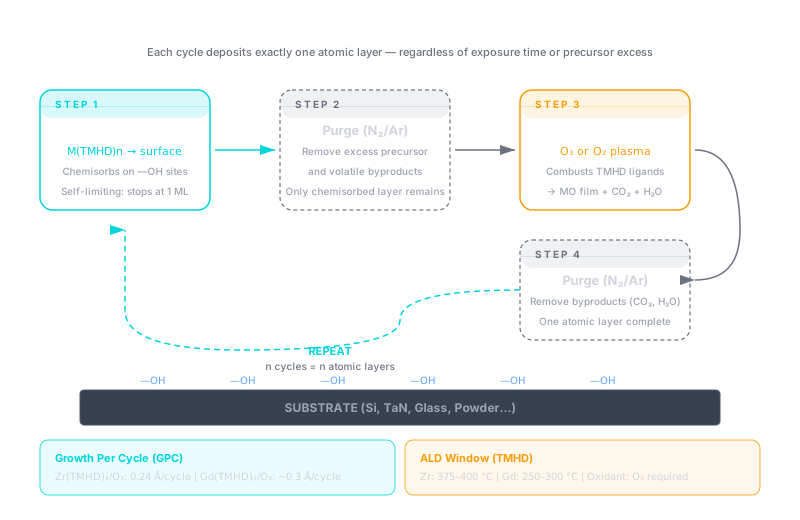
The Chelate Advantage
TMHD (2,2,6,6-tetramethyl-3,5-heptanedionate) is a β-diketonate ligand where two oxygen donors chelate the metal center. Three design features make it well-suited for high-temperature ALD:
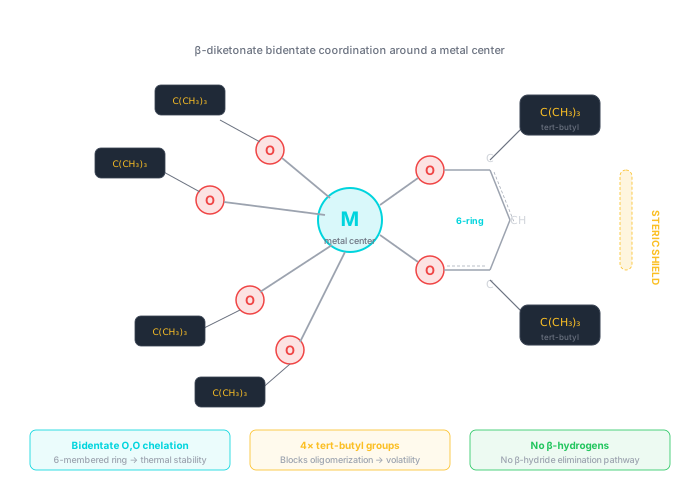
Chelate effect
Bidentate coordination creates a thermodynamically stable six-membered ring, resisting ligand dissociation in heated delivery lines.
Steric shielding
Four tert-butyl groups surround the metal center, blocking oligomerization and supporting consistent vapor pressure across batches.
No β-hydrogens
The absence of β-hydrogens eliminates the β-hydride elimination pathway that causes premature decomposition in amide precursors above ~250 °C.
Ligand Family Comparison
How β-diketonates compare with other ALD precursor chemistries. Each family trades off stability, reactivity, and integration flexibility.
| Ligand Family | Thermal Stability | Reactivity | ALD Window | Best For |
|---|---|---|---|---|
| β-Diketonates (TMHD/thd) Zr(TMHD)₄, Cu(TMHD)₂, Gd(TMHD)₃ | Excellent — no β-hydrogens to enable premature decomposition | Low — requires strong oxidants (O₃ or plasma) | 250–400 °C (precursor-dependent) | High-temperature oxide epitaxy, complex oxides (PZT, YBCO), R&D-to-pilot process development where delivery-line stability is paramount |
| Alkylamides (TDMA-class) TDMAZ, TEMAZ, TDMAH | Poor — weak M–N bonds susceptible to homolysis | Excellent — reacts with H₂O at low temperatures | 150–250 °C (narrow ceiling due to decomposition) | Low-temperature ALD (<250 °C), OLED encapsulation, perovskite interfaces. Dominant for high-volume HfO₂/ZrO₂ production ALD at leading-edge fabs |
| Amidinates & Guanidinates Cu(I) amidinates, Ru amidinates | Good — chelate ring improves stability vs amides | Good — highly reactive M–N bonds, H₂-reducible | 150–300 °C | Metallic Cu/Ru ALD at moderate temperatures, barrier-less interconnects |
| Alkoxides ZTB (Zr tert-butoxide), Ti(OiPr)₄ | Moderate | Moderate to good with H₂O | 200–350 °C | Specific oxide depositions where direct M–O is advantageous and thermal budget is moderate |
| Cyclopentadienyls (Cp) Gd(iPrCp)₃, Cp₂ZrMe₂ | Moderate — strong M–C bonds but can decompose >250 °C | Good — reactive with H₂O and O₃ | 200–365 °C (precursor-dependent) | High-GPC oxide deposition where moderate temperatures and H₂O compatibility are needed |
Known Limitations of TMHD Precursors
We believe honest technical communication is more valuable than marketing. Here is where TMHD is not the right choice:
High deposition temperatures
ALD windows of 250–400 °C exclude use on organic substrates, perovskite absorbers, and other temperature-sensitive layers.
Ozone or plasma required
H₂O is insufficient for TMHD ligand cleavage. Processes without O₃ or plasma capability cannot use TMHD precursors.
Carbon incorporation risk
At suboptimal temperature or insufficient O₃ dose, incomplete ligand combustion leaves carbon residues (especially for Gd at ~2.3 at.% C).
Lower GPC vs newer chemistries
0.24–0.3 Å/cycle is lower than amide-based (~1.25 Å) or Cp-based (~1.4 Å) alternatives, meaning longer cycle counts for equivalent thickness.
Product Portfolio
Three Precursors, One Platform
All TMHD precursors share the same halide-free, thermally robust ligand architecture. Each is optimized for specific metal oxide or metallic film targets.
Zirconium (Zr)
Zr(TMHD)₄
C₄₄H₇₆O₈Zr
Vaporization
Sublimes at 180–220 °C under vacuum (~0.1–1.0 Torr). At atmospheric pressure, melts at 318–339 °C before decomposing.
ALD Window
375–400 °C with O₃
GPC: 0.24 Å/cycle (self-limiting plateau)
Target Films
- • ZrO₂ (monoclinic + orthorhombic)
- • PZT components
- • Zr-doped dielectrics
Key Film Properties
- • Dielectric constant k = 24–32
- • Leakage: 3.3 × 10⁻⁶ A/cm² at 1 MV/cm
- • Carbon/hydrogen <0.5 at.% in optimal ALD window
- • Stoichiometric, highly crystalline films
Competitive Advantage
High thermal stability minimizes decomposition risk in heated delivery lines. Halide-free — no Cl/F contamination pathway. Air-stable solid handling simplifies logistics. Well-suited for R&D and pilot-scale process development. Note: high-volume fab production ALD for ZrO₂ typically uses amide-class precursors (TDMAZ/TEMAZ) for their lower deposition temperatures and higher GPC.
Limitations
High ALD window (375–400 °C) limits use on temperature-sensitive substrates. O₃ required as oxidant. Lower GPC than amide-based Zr precursors. Amide precursors dominate high-volume ZrO₂ ALD in leading-edge fabs.
Copper (Cu)
Cu(TMHD)₂
C₂₂H₃₈CuO₄
Vaporization
Vaporizes at ~120–140 °C
Target Films
- • Metallic Cu (via H₂ plasma or reducing agents)
- • Cu₂O (via H₂O or O₃ at 80–160 °C)
- • CuO (via oxidation at 250–550 °C)
Key Film Properties
- • Metallic Cu resistivity: 1.78–8 µΩ·cm (thickness-dependent)
- • Cu₂O: p-type, resistivity 31–83 Ω·cm, bandgap 1.99–2.41 eV
- • CuO: resistivity ~16 Ω·cm, bandgap ~1.42 eV ,
- • Excellent adhesion to TaN/TiN barrier layers
Competitive Advantage
Entirely fluorine-free — no HF byproducts that corrode reactor components and etch barrier layers (unlike Cu(hfac)₂). Oxidation-state versatility: Cu⁰, Cu₂O, or CuO tunable by co-reactant and temperature.
Limitations
For direct metallic Cu ALD, industry has largely moved to Cu(I) amidinates which offer higher reactivity with molecular H₂ at low temperatures. Cu(TMHD)₂ ALD is substrate/catalyst-dependent for metallic Cu.
Gadolinium (Gd)
Gd(TMHD)₃
C₃₃H₅₇GdO₆
Vaporization
Sublimes cleanly at moderate temperatures under vacuum
ALD Window
250–300 °C with O₃
GPC: ~0.3 Å/cycle
Target Films
- • Gd₂O₃ (cubic C-type)
- • Gd-doped HfO₂/ZrO₂
- • GdScO₃
Key Film Properties
- • Dielectric constant k ≈ 9–14 (ALD Gd₂O₃; up to ~20+ for ternary GdScO₃)
- • Wide optical bandgap
- • Amorphous below 250 °C; cubic crystalline above
- • Carbon ~2.3 at.%, hydrogen ~1.7 at.% (higher than Zr)
Competitive Advantage
Extended shelf stability under inert conditions. Strong resistance to thermal degradation in delivery lines. Preferred for demanding high-temperature environments where Cp-based alternatives may decompose.
Limitations
Higher carbon/hydrogen incorporation (~2.3/1.7 at.%) vs Zr films. Lower GPC than Cp-based Gd precursors (~1.4 Å/cycle for Gd(iPrCp)₃). Requires O₃, not H₂O.
Need a Different Metal or Ligand?
We synthesize custom precursors with any metal center and engineered ligand architectures — β-diketonates, amides, amidinates, alkoxides, or Cp derivatives. NDA protection available.
Custom Synthesis CapabilitiesApplication Guide
Where TMHD Precursors Excel — and Where They Don't
Select an application to see precursor recommendations, film performance targets, and honest assessments of where TMHD is the right choice.
ALD ZrO₂, Gd₂O₃, and Gd-doped HfO₂ are critical high-k dielectric materials for advanced CMOS nodes (FinFET, GAA). Halide-free TMHD precursors avoid precursor-derived Cl⁻ trap formation, which can degrade charge carrier mobility and dielectric reliability.
Key Requirements
- Self-limiting ALD growth at 375–400 °C (Zr) or 250–300 °C (Gd)
- Ozone co-reactant for complete ligand combustion
- Trace metal impurities <50 ppb (industry target)
- Sub-0.5 at.% carbon in deposited films
Performance Targets
| Dielectric constant (ZrO₂) | k = 24–32 | [R2] |
| Dielectric constant (Gd₂O₃) | k ≈ 9–14 (binary oxide); k > 20 for ternary GdScO₃ | [R9], [R22], [R17] |
| Leakage current (ZrO₂) | 3.3 × 10⁻⁶ A/cm² at 1 MV/cm | [R2] |
| Carbon content | <0.5 at.% (Zr), ~2.3 at.% (Gd) | [R1], [R9] |
Why TMHD
TMHD eliminates the Cl⁻ contamination pathway inherent to halide precursors like HfCl₄/ZrCl₄ (1–3 at.% residual Cl). No HF corrosion risk (vs fluorinated alternatives). Extreme delivery-line stability prevents parasitic CVD in long heated lines.
[R1], [R2], [R11]
Discuss This ApplicationQuality & Analytical
Why Purity Matters at Advanced Nodes
At sub-5 nm technology nodes, even ppb-level contaminants shift threshold voltages, create leakage paths, and degrade device reliability. Precursor purity is not a specification — it is a yield driver.
Contamination Impact & TMHD Advantage
| Contaminant | Impact on Films | Threshold | TMHD Advantage |
|---|---|---|---|
| Chloride (Cl⁻) Halide-based precursors (HfCl₄, ZrCl₄, TiCl₄) | Trapped Cl⁻ ions act as electron traps, shifting threshold voltage and degrading dielectric reliability. 1–3 at.% residual Cl typical in films from HfCl₄ at ~300 °C. | ≤10 ppm in precursor (electronic grade target) | TMHD ligands contain no halogen atoms, avoiding precursor-derived Cl contamination at the molecular level rather than managing it through post-deposition anneal. |
| Fluorine (F⁻) Fluorinated precursors (Cu(hfac)₂, HFIP-based) | HF byproduct corrodes reactor walls, etches TaN/TiN barrier layers, and embeds F⁻ as charge traps in gate dielectrics. | Zero (not present in TMHD chemistry) | Cu(TMHD)₂ is a fluorine-free Cu(II) precursor for ALD/CVD, avoiding the HF byproducts associated with fluorinated alternatives. |
| Carbon (C) Incomplete ligand combustion during ALD | Residual C creates leakage paths in dielectric films and increases resistivity in metallic films. Acceptable levels depend on film function. | <0.5 at.% (Zr, optimal), <3 at.% (Gd, typical) | O₃ as co-reactant combusts TMHD ligands more completely than H₂O-based processes. Carbon is minimized within the verified ALD window., |
| Trace metals Precursor synthesis impurities, metal exchange | Even ppb-level contamination at advanced nodes can shift electrical properties. Particularly critical for DRAM and CMOS high-k. | <50 ppb total metals (electronic grade target) | Sublimation purification of TMHD compounds provides an inherent secondary purification step. Solid handling avoids liquid-phase metal exchange., |
| Moisture (H₂O) Precursor storage and handling | Premature hydrolysis degrades precursor performance and causes particulate formation in delivery systems. | <100 ppm by Karl Fischer | TMHD solids are more air-stable than liquid amide or alkoxide precursors, reducing hydrolysis risk during handling and transport., |
The Halide-Free Advantage
Halide & Fluorinated Precursors (HfCl₄, ZrCl₄, Cu(hfac)₂)
- • HfCl₄: 1–3 at.% residual Cl at ~300 °C
- • Cl⁻ ions act as electron traps → threshold voltage shift
- • Cu(hfac)₂: HF byproduct corrodes reactor walls
- • F⁻ etches TaN/TiN barrier layers
- • Requires F-resistant reactor hardware
TMHD Precursors
- • Zero halogen atoms in the ligand
- • Cl/F contamination eliminated at molecular level
- • No HF corrosion — standard reactor hardware
- • No post-deposition anneal needed for halide removal
- • Byproducts: CO₂, H₂O (benign)
Carbon Contamination Management
Carbon incorporation is the primary contamination concern for TMHD-based ALD. With proper process optimization, it is manageable:
ZrO₂ (Optimal)
<0.5 at.%
C and H by TOF-ERDA at 375–400 °C with O₃
Gd₂O₃ (Typical)
~2.3 at.% C
Higher due to larger ligand:metal ratio. ~1.7 at.% H.
Mitigation
Adequate temperature within ALD window + sufficient O₃ pulse duration. Extended purge to remove byproducts.
Electronic-Grade Purity Targets
Industry-standard specifications that Mironova targets for electronic-grade precursors.
| Parameter | Target | Note |
|---|---|---|
| Assay purity | ≥99.0% | By NMR or titration. Standard for research-grade metal-organic precursors. |
| Trace metals | <50 ppb total | Typical electronic-grade target. Verified by ICP-MS. |
| Halide content | ≤10 ppm (Cl⁻) | TMHD synthesis is inherently halide-free. Target reflects trace contamination limits. |
| Residual moisture | <100 ppm | Measured by Karl Fischer titration. Critical for delivery system compatibility. |
| Non-volatile residue | <0.1% by weight | TGA confirms complete sublimation/evaporation. Prevents buildup in delivery lines. |
Analytical Capabilities
ICP-MS
Inductively Coupled Plasma Mass Spectrometry
Trace metal impurities at ppb and sub-ppb levels
Confirms trace metal content meets <50 ppb electronic-grade targets
TGA/DSC
Thermogravimetric Analysis / Differential Scanning Calorimetry
Mass loss vs temperature, phase transitions, decomposition onset
Validates sublimation profile, thermal stability window, and absence of non-volatile residue
NMR
Nuclear Magnetic Resonance Spectroscopy
¹H and ¹³C spectra confirming ligand environment and coordination
Verifies molecular structure, chelation integrity, and absence of free ligand or hydrolysis products
Karl Fischer
Karl Fischer Titration
Residual moisture content in ppm
Confirms moisture levels below specification to prevent hydrolysis in delivery systems
XRD
X-ray Diffraction
Crystalline phase identification and purity
Confirms expected crystal structure and absence of secondary phases
Custom Synthesis
Any Metal. Engineered Ligand. To Spec.
When off-the-shelf precursors don't match your process window, we design and synthesize custom metal-organic compounds tailored to your deposition requirements.
Ligand Engineering
β-Diketonates, amides, amidinates, guanidinates, alkoxides, and cyclopentadienyl derivatives. Homoleptic or heteroleptic architectures with tuned volatility, reactivity, and thermal stability.
Air-Sensitive Chemistry
Full Schlenk-line and glovebox capabilities for pyrophoric and moisture-sensitive precursors. Inert-atmosphere synthesis, purification, and packaging.
Heteroleptic Design
Mixed-ligand precursors that combine the thermal stability of one ligand class with the reactivity of another. Tailored to your specific process window.
Sublimation Purification
Vacuum sublimation for electronic-grade final purification. Removes trace metals and non-volatile residues below ICP-MS detection limits.
NDA & IP Protection
Full NDA framework for novel precursor development. Your proprietary chemistry stays confidential through synthesis, characterization, and delivery.
~4-Week Lead Time
From specification to characterized product. 25 g minimum order for R&D evaluation, scaling to kg+ for process qualification.
Expanding Metal Portfolio
Beyond Zr, Cu, and Gd, we are building synthesis capabilities for next-generation interconnect and barrier metals driven by leading-edge semiconductor demand.
Ruthenium (Ru)
Barrier-less interconnects for sub-10 nm nodes. Ru ALD using amidinates achieves ~10 µΩ·cm. Growing demand from leading-edge foundries.
Molybdenum (Mo)
Emerging contact metal for GAA transistors. Mo fills narrow contact trenches with lower resistivity than W at small dimensions.
Cobalt (Co)
Via fill and barrier applications at advanced nodes. Co ALD is increasingly adopted where Cu electromigration is a concern.
Supply Chain
Domestic Supply for Critical Materials
CHIPS-funded fabs must build domestic, traceable supply chains — and that requirement flows down to every chemical supplier. Mironova provides US-manufactured precursors with full batch traceability and provenance documentation, making us a strategically valuable partner for CHIPS Act supply ecosystems.
US Manufacturing & Domestic Sourcing
Fairfield, NJ
All TMHD precursors synthesized and purified at our Fairfield, NJ facility. No dependency on overseas toll manufacturing, no China-linked intermediates. Full chain-of-custody from raw materials to packaged precursor — meeting the domestic sourcing expectations that CHIPS-funded fabs require from their supply chain.
CHIPS Act Supply-Chain Readiness
The CHIPS and Science Act (2022) allocates $39B for domestic semiconductor manufacturing and $11B for R&D. While the Act does not mandate domestic precursor sourcing directly, CHIPS funding recipients must demonstrate supply chain traceability, provenance documentation, and compliance with national security guardrails — all of which flow down to chemical suppliers. Mironova provides batch-level traceability, raw material sourcing transparency, and full COA documentation aligned with these requirements.
Strategic Supply Chain Value
Most specialty metal precursors are concentrated in Asia, creating single-source risk for fab operations. The CHIPS Act is driving demand for domestic, trusted suppliers — even for niche reagents. US-manufactured precursors with full provenance documentation are not just procurement-convenient; they are strategically valuable to fabs building CHIPS-ready supply ecosystems.
Market Context
The ALD/CVD precursor market is estimated at $1.2–1.9B (2024) with 6.5–10% CAGR through 2029–2032. High-k dielectric precursors (Zr, Hf, rare-earth) are among the steepest growth segments, driven by GAA transistor adoption and advanced DRAM.
Resources
Technical Guides & Process Data
Engineer-facing resources for evaluating and integrating TMHD precursors into your ALD/CVD workflows. Literature-backed protocols, characterization checklists, and comparison data.
Technical Inquiry
Discuss Your Precursor Needs
Whether you need one of our catalog TMHD precursors or a custom metal-organic compound, we can help you find the right chemistry for your deposition process.
Technical Consultation
Our chemistry team evaluates your process requirements and recommends optimal precursor chemistry, delivery conditions, and co-reactant selection.
NDA Protection
Full confidentiality framework for proprietary processes. Your chemistry and integration details stay protected.
~4 Week Lead Time
From specification to characterized product. 25 g minimum for R&D, scaling to kg+ for process qualification.
References
Literature & Sources
Technical claims on this page are grounded in peer-reviewed literature and industry data. DOIs are provided where available.
Peer-Reviewed Literature
Zirconia Thin Films by Atomic Layer Epitaxy: A Comparative Study on the Use of Novel Precursors with Ozone
Putkonen M, Niinistö J, Kukli K, et al.
J. Mater. Chem.
Zr(thd)₄/O₃ ALD window at 375–400 °C, GPC 0.24 Å/cycle, monoclinic ZrO₂ with <0.5 at.% C and H impurities by TOF-ERDA.
Atomic Layer Deposition of ZrO₂ Thin Films Using Zr(thd)₄ and Ozone
Niinistö J, et al.
Thin Solid Films
Confirms self-limiting growth plateau at 375–400 °C with 0.24 Å/cycle GPC. ZrO₂ films exhibit k = 24–32 and leakage of 3.3 × 10⁻⁶ A/cm² at 1 MV/cm.
Structure and Dielectric Property of High-k ZrO₂ Films Grown by ALD Using TDMAZ and Ozone
Liu J, Li J, et al.
Nanoscale Research Letters
TDMAZ+O₃ ALD window 200–250 °C with higher GPC (~1.25 Å/cycle), but suffers severe thermal decomposition above 250 °C causing parasitic CVD.
Vapour Pressure and Heat Capacities of Metal Organic Precursors: Y(thd)₃ and Zr(thd)₄
Fulem M, Růžička K, et al.
J. Crystal Growth
Peer-reviewed vapor pressure measurements for Zr(thd)₄. Sublimation enthalpy 85.36 ± 3.60 kJ/mol. Sublimes effectively at 180–220 °C under vacuum (~0.1–1.0 Torr).
Trends in Copper Precursor Development for CVD and ALD Applications
Gordon PG, Kurek A, Barry ST
ECS J. Solid State Sci. Technol.
Comprehensive review of Cu precursors. Cu(thd)₂ is fluorine-free (vs Cu(hfac)₂ HF corrosion), but industry trending toward Cu(I) amidinates for low-T metallic Cu ALD.
Growth of (111)-Textured Copper Thin Films by Atomic Layer Deposition
Mane AU, Shivashankar SA
J. Crystal Growth
Cu(thd)₂ ALD using H₂ reduction yields highly textured Cu films. Vaporization at ~120–140 °C. Process is substrate/catalyst-dependent.
Atomic Layer Chemical Vapour Deposition of Copper
Mane AU, Shivashankar SA
Mater. Sci. Semicond. Process.
Cu resistivities from ~4.25 µΩ·cm (20 nm) to ~1.78 µΩ·cm (120 nm) with excellent adhesion on TiN/TaN at 300 °C.
A Low Temperature Growth of Cu₂O Thin Films as Hole Transporting Material for Perovskite Solar Cells
Pellegrino AL, Lo Presti F, et al.
Materials
Cu₂O from Cu(tmhd)₂ MOCVD: phase-pure p-type, stabilized at 250 °C. Resistivity 31–83 Ω·cm, bandgap 1.99–2.41 eV. CuO at higher temperatures.
Gadolinium Oxide Thin Films by Atomic Layer Deposition
Niinistö J, Petrova N, et al.
J. Crystal Growth
Gd(thd)₃/O₃ ALD: self-limiting at ~300 °C, GPC ~0.3 Å/cycle. Film impurities: ~2.3 at.% C, ~1.7 at.% H. Cubic C-type Gd₂O₃ above 250 °C.
Plasma-Enhanced Atomic Layer Deposition and Etching of High-k Gadolinium Oxide
Vitale SA, et al.
J. Vac. Sci. Technol. A
PE-ALD using Gd(iPrCp)₃ + O₂ plasma: higher GPC (~1.4 Å/cycle at 250 °C) but narrower window and moisture sensitivity compared to Gd(thd)₃.
Chlorine Contamination in HfO₂ Films Deposited by ALD Using HfCl₄
Park PK, Kang S-W, et al.
J. Phys. Chem. C
HfCl₄/H₂O ALD leaves 1–3 at.% residual Cl at ~300 °C, acting as electron traps that degrade dielectric performance. Halide-free precursors eliminate this.
Common Precursors and Surface Mechanisms for Atomic Layer Deposition
Winter CH, et al.
Comprehensive Organometallic Chemistry IV
Comprehensive review of ALD precursor chemistry families, surface mechanisms, and ligand design principles for next-generation deposition processes.
Thin Film Encapsulation for Organic Light Emitting Diodes by ALD
Meyer J, et al.
Adv. Mater.
ALD Al₂O₃/ZrO₂ nanolaminates achieve WVTR <10⁻⁶ g/m²/day for OLED encapsulation. Requires low-temperature (<100 °C) ALD — incompatible with TMHD precursors.
All-Perovskite Tandem Solar Cells with ALD SnOₓ Electron Transport Layer
Johnson B, et al.
Joule
ALD SnOₓ on fullerenes with in-situ O₃ functionalization enables >24% efficiency perovskite tandems. Perovskite degrades above ~150 °C — TMHD incompatible for direct deposition.
Low Temperature Growth of High Purity, Low Resistivity Copper Films by Atomic Layer Deposition
Knisley TJ, et al.
Chem. Mater.
Low-temperature Cu ALD using Cu(I) amidinate achieves high-purity metallic Cu with molecular H₂, demonstrating the newer precursor class that has partially displaced Cu(thd)₂ for metallic Cu.
Atomic Layer Deposition of Ruthenium Using Bis(N,N′-di-tert-butylacetamidinato)ruthenium(II) Dicarbonyl and NH₃
Li H, et al.
J. Electrochem. Soc.
Ru amidinate ALD achieves ~10 µΩ·cm resistivity, approaching bulk Ru. Demonstrates barrier-less Ru interconnect potential for sub-10 nm nodes.
Gadolinium Scandate: Next Candidate for Alternative Gate Dielectric in CMOS Technology?
Fröhlich K, Fedor J, Kostič I, Maňka J, Ballo P
J. Electrical Engineering
MOCVD GdScO₃ at 600 °C maintains amorphous phase through 1000 °C RTA, preventing grain boundary leakage. k > 20 for the ternary scandate (GdScO₃), not binary Gd₂O₃. Validates Gd-based ternary high-k dielectrics for advanced nodes.
Emerging Applications of Atomic Layer Deposition for Lithium-Ion Battery Materials
Meng X, et al.
Adv. Mater.
Review of ALD for conformal electrode coatings and solid electrolytes. Ultra-high precursor purity is critical for electrochemical stability and long-term cycling.
Substituent Effects on the Volatility of Metal β-Diketonates
Fahlman BD, Barron AR
Adv. Mater. Opt. Electron.
Systematic study of substituent effects on β-diketonate volatility. tert-Butyl groups (TMHD) maximize steric shielding, prevent oligomerization, and enhance vapor pressure.
Realization of Thin Film Encapsulation by ALD of Al₂O₃ at Low Temperature
Yang Y-Q, Duan Y, et al.
J. Phys. Chem. C
WVTR of ~8.7×10⁻⁶ g/m²/day achieved with O₃-based Al₂O₃ ALD at 80 °C. Confirms low-temperature ALD requirement for OLED — TMHD precursors excluded.
Atomic Layer Deposition of Ru in nanoTSV with High Coverage and Low Resistivity
Chen Z, et al.
Nanoscale Advances
ALD Ru with ~15 µΩ·cm resistivity in nano-TSV structures, demonstrating strategic Ru interconnect momentum for next-generation nodes.
ALD of Rare Earth Oxide Thin Films from β-Diketonate Precursors
Päiväsaari J, Putkonen M, Niinistö L
Thin Solid Films
ALD of Ln₂O₃ (Ln = La, Pr, Nd, Gd) from Ln(thd)₃/O₃. Measured dielectric constants for binary Ln₂O₃ films: k = 8.4–11.1 across the series. Gd(thd)₃/O₃ yields k ≈ 9–13, significantly lower than the k > 20 values reported for the ternary GdScO₃.
Copper Oxide Thin Films Prepared by Chemical Vapor Deposition from Copper Dipivaloylmethanate
Maruyama T
Jpn. J. Appl. Phys.
CuO films by thermal CVD from Cu(DPM)₂ (= Cu(TMHD)₂) at 350–550 °C. Reports resistivity ~16 Ω·cm and bandgap ~1.42 eV for CuO films, consistent with subsequent studies.
Growth and Characterization of CuO Thin Films Grown by Chemical Spray Pyrolysis
Zhang Q, Zhang K, Xu D, Yang G, Huang H, Nie F, Liu C, Yang S
Materials
CuO films with resistivity in the range of 10–30 Ω·cm and bandgap 1.3–1.5 eV, corroborating the Cu(TMHD)₂-derived CuO values from Maruyama 1998.
Gd-Doped ZrO₂ as a High-k DRAM Capacitor Dielectric with Reduced Leakage via p-Type Acceptor Mechanism
Lee J, et al.
ACS Applied Electronic Materials
Gd doping in ZrO₂ achieves EOT of 0.76 nm with improved leakage characteristics via a p-type acceptor mechanism. Provides the strongest published argument for Gd(TMHD)₃ as a demand vector in advanced DRAM capacitor dielectrics.
Superlattice HfO₂–ZrO₂ Films with Ultrahigh Dielectric Constant
Yao Y, et al.
Nature Materials
SL-Hf₀.₃Zr₀.₇O₂ superlattice films achieve dielectric constant k ≈ 59, far exceeding binary HfO₂ or ZrO₂. Strengthens the narrative for Zr-based precursors in next-generation ferroelectric and superlattice architectures.
Market & Industry Data
ALD/CVD Precursor Market Outlook
TECHCET
ALD/CVD precursor market ~$1.2–1.9B in 2024 with 6.5–10% CAGR through 2029–2032. High-k dielectric segment (Zr, Hf, rare-earth) is among the steepest growth trajectories.
See How Teams Use These Products
Evaluation guides tailored to your industry — see which products fit your application, review key evidence, and request samples.
FAQ
Frequently Asked Questions
Common technical questions about this product line, answered by our scientific team.
Related Resources
Technical data, product specifications, and application guidance.