
DMTMM Science Hub
Mechanism of action, application protocols, and comparative coupling data.
DMTMM coupling reagents
High-purity CDMT (2-chloro-4,6-dimethoxy-1,3,5-triazine) — the activated triazine precursor for in-situ DMTMM generation and direct amide bond formation in organic media.
Also known as 2-Chloro-4,6-dimethoxy-1,3,5-triazine · 2-Chloro-4,6-dimethoxytriazine · Chlorodimethoxytriazine
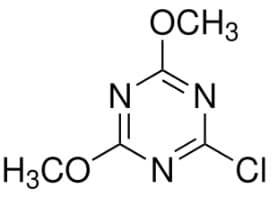
Pricing and lead time are confirmed by quotation. Include the product name, quantity and intended application in your inquiry.
Request a quotationFor professional research, development and manufacturing. Use appropriate personal protective equipment and ventilation. Refer to the Safety Data Sheet for complete handling and safety information.
Store at room temperature in a dry place, protect from moisture
CDMT (2-chloro-4,6-dimethoxy-1,3,5-triazine) is the neutral, activated triazine core that underpins the entire DMTMM product family. It is widely used both as a standalone carboxylic acid activating agent and as the direct precursor for in-situ generation of DMTMM coupling reagents. When combined with a tertiary amine such as N-methylmorpholine (NMM), CDMT rapidly forms the corresponding DMTMM salt in situ, enabling flexible, on-demand access to triazine-based coupling chemistry.
CDMT is the starting point for generating any DMTMM salt variant in situ. By selecting the tertiary amine partner, chemists can tune the counterion and solubility profile of the resulting coupling species on demand — eliminating the need to stock multiple pre-formed salts.
CDMT activates amino acid carboxyl groups under mild conditions with minimal epimerization, suitable for both solution-phase and solid-phase peptide workflows.
Effective for coupling small molecules, crosslinkers, or functional groups onto hyaluronic acid, chitosan, alginate, and other biopolymers, particularly in non-aqueous or mixed-solvent systems.
Used by process chemists who require a specific DMTMM salt variant — including novel counterion combinations — as part of proprietary synthesis routes or regulatory filings.
CDMT is produced through controlled synthesis with rigorous quality control at Mironova Labs. Our material meets pharmaceutical-grade purity standards, ensuring batch-to-batch consistency for demanding applications.
We offer CDMT from research quantities (100 g) to commercial scale (50 kg+) with consistent quality. Custom packaging and labeling available upon request.
⚠️ Warning: CDMT is a reactive chlorinated triazine reagent intended for laboratory and manufacturing use only by qualified professionals. Handle with appropriate PPE including gloves, safety glasses, and lab coat. Avoid contact with skin, eyes, and mucous membranes. Keep away from moisture and protic solvents prior to use. Refer to SDS for complete safety information.
| Property | Specification |
|---|---|
| Purity | ≥99.0% (HPLC) |
| Appearance | White crystalline powder |
| Solubility | Soluble in THF, DCM, DMF, and acetonitrile; sparingly soluble in water |
| Storage | Store at room temperature in a dry place, protect from moisture |
Safety Data Sheet
Safety and handling informationProduct specification
Product limits and analytical requirementsCertificate of Analysis
Measured results for the supplied lotApplication context
Mechanism of action, application protocols, and comparative coupling data.
No guanidinylation, water-tolerant, scale economics
Higher on-DNA conversion than HATU in published comparisons
Outperforms EDC/NHS in water — no persistent residues, no pre-activation
Higher substitution than EDC/NHS, no pH gymnastics
Clean aqueous coupling for modification steps in oligo synthesis