Kopyrrol Aqua
INCI: PYRROLIDINYL DIAMINOPYRIMIDINE OXIDE OXOTHIAZOLIDINECARBOXYLATE
Also known as: PDPO · OTZ Salt, Pyrrolidinyl Diaminopyrimidine Oxide Oxothiazolidinecarboxylate
Water-soluble salt of Pyrrolidinyl Diaminopyrimidine Oxide (PDPO) and Oxothiazolidinecarboxylic Acid (OTZ). A structural analog of minoxidil in the potassium channel opener class for cosmetic hair enhancement formulations.
Chemical Structure
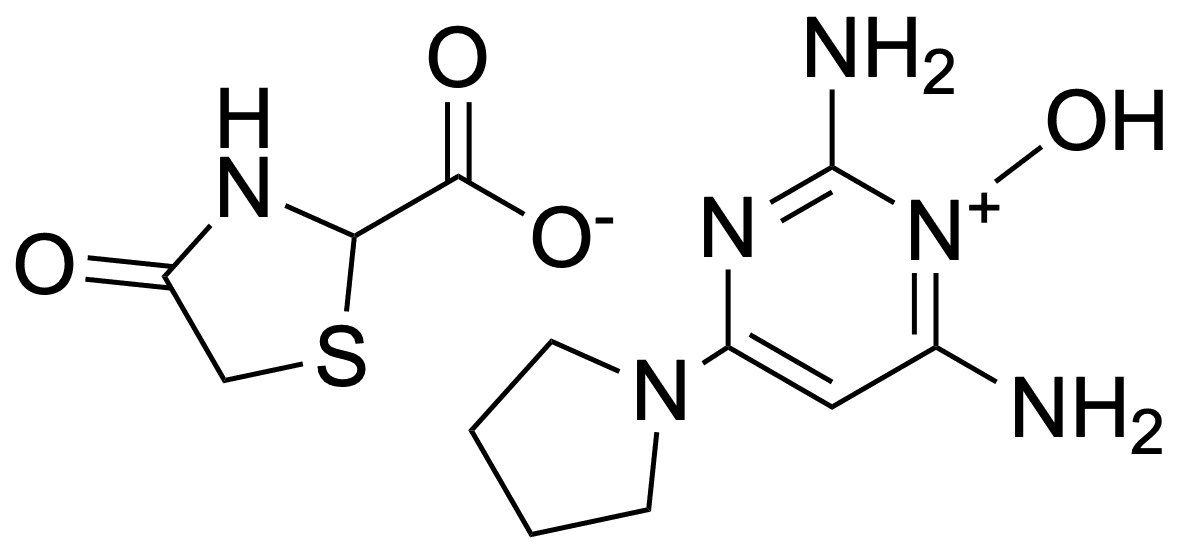
Product Information
INCI Name
PYRROLIDINYL DIAMINOPYRIMIDINE OXIDE OXOTHIAZOLIDINECARBOXYLATE
Use Level
0.2–1.5% (w/w)
pH (1.5% aq.)
3.0–4.0 (1.5% aqueous solution)
Prices and lead time available upon request
Product Documents
Safety Data Sheet (SDS)
Available on request
Technical Data Sheet (TDS)
Available on request
Certificate of Analysis
Provided with order
Overview
Kopyrrol Aqua is the water-soluble salt form of Pyrrolidinyl Diaminopyrimidine Oxide (PDPO) paired with Oxothiazolidinecarboxylic Acid (OTZ). By converting the poorly water-soluble PDPO free base into an OTZ salt, Mironova Labs provides a cosmetically elegant form that dissolves readily into aqueous formulations without co-solvents, simplifying integration into serums, lotions, and scalp treatments.
Mechanism of Action
PDPO shares the 2,4-diaminopyrimidine N-oxide pharmacophore with minoxidil. The compound class is associated with several follicular signaling pathways:
- Potassium channel biology — Human hair follicles express ATP-sensitive K⁺ channels responsive to the minoxidil class (Shorter et al., FASEB J, 2008). PDPO is structurally related to minoxidil, though PDPO-specific K⁺ channel activity has not been characterized in published studies.
- Compound-class precedent — Minoxidil has been shown to activate β-catenin signaling in dermal papilla cells (Kwack et al., 2011) and upregulate VEGF expression (Lachgar et al., 1998). These pathways are documented for minoxidil but have not been independently confirmed for PDPO.
- OTZ contribution — The oxothiazolidinecarboxylate counterion is a well-characterized cysteine prodrug, first described by Williamson & Meister (PNAS, 1981) as a substrate for 5-oxo-L-prolinase that yields intracellular L-cysteine. OTZ supports glutathione synthesis and provides cysteine for keratin biosynthesis. Topical penetration through reconstructed human epidermis has been demonstrated (Jacques et al., Int. J. Cosmetic Science, 2021).
Composition
The salt is formed from approximately 50–60% PDPO and 40–50% OTZ by weight, with the precise stoichiometry confirmed by HPLC and elemental analysis for each batch.
Formulation Notes
- Compatible with most aqueous cosmetic systems (serums, tonics, lotions, shampoos)
- Functional at neutral to mildly acidic pH; formulate at pH 4.0–6.5 for optimal stability
- Recommended use level: 0.2–1.5% w/w for leave-on scalp products
- May be combined with other hair-active ingredients such as caffeine, niacinamide, or biotin
Regulatory Information
Kopyrrol Aqua is identified by its INCI name PYRROLIDINYL DIAMINOPYRIMIDINE OXIDE OXOTHIAZOLIDINECARBOXYLATE. This salt does not have an assigned CAS number; the free base (PDPO) corresponds to CAS 55921-65-8. Formulators are responsible for ensuring compliance with local cosmetic regulations.
Related Resources
Technical data, product specifications, and application guidance.
Questions About This Ingredient?
Our technical team can discuss specifications, sample requests, and custom synthesis options.