Kopexil Aqua
INCI: DIAMINOPYRIMIDINE OXIDE OXOTHIAZOLIDINECARBOXYLATE
Also known as: DPO · OTZ Salt, Diaminopyrimidine Oxide Oxothiazolidinecarboxylate
Water-soluble salt of Diaminopyrimidine Oxide (DPO / Aminexil) and Oxothiazolidinecarboxylic Acid (OTZ). A cosmetic active ingredient featuring a cysteine prodrug counterion for collagen maturation modulation in scalp formulations.
Chemical Structure
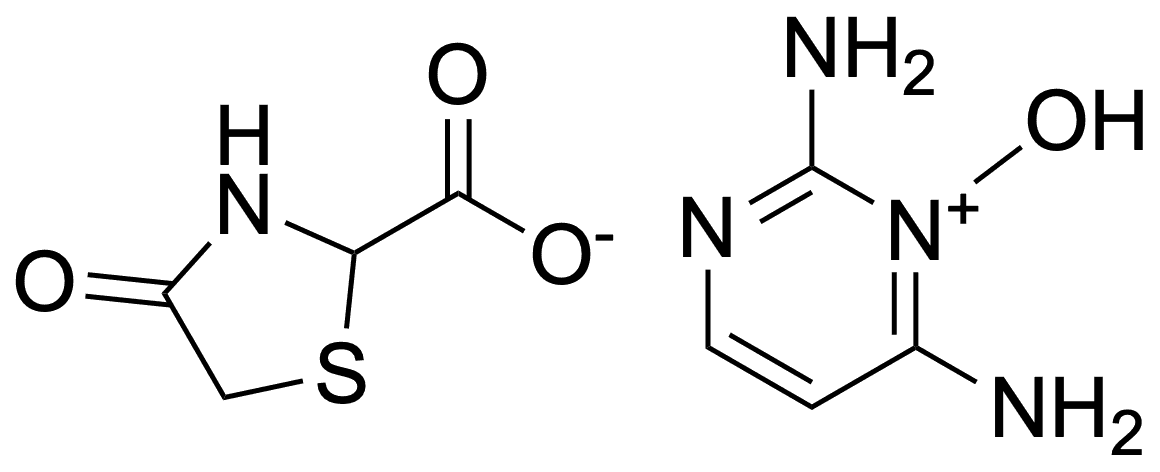
Product Information
INCI Name
DIAMINOPYRIMIDINE OXIDE OXOTHIAZOLIDINECARBOXYLATE
Use Level
0.2–1.5% (w/w)
pH (1.5% aq.)
2.0–3.0 (1.5% aqueous solution)
Prices and lead time available upon request
Product Documents
Safety Data Sheet (SDS)
Available on request
Technical Data Sheet (TDS)
Available on request
Certificate of Analysis
Provided with order
Overview
Kopexil Aqua is the water-soluble salt form of Diaminopyrimidine Oxide (DPO) combined with Oxothiazolidinecarboxylic Acid (OTZ). While DPO has historically been used in cosmetic hair-care compositions, its limited water solubility has restricted formulation options. Mironova Labs addresses this by providing the OTZ salt form, which dissolves freely in water and enables precise dosing in clear, aqueous leave-on and rinse-off products.
Mechanism of Action
DPO (aminexil) is a 2,4-diaminopyrimidine-3-oxide with a distinct mechanism of action compared to other compounds in this chemical class:
- Collagen maturation modulation — Mahé et al. (Skin Pharmacology, 1996) demonstrated that DPO retains strong modulation of lysyl hydroxylase mRNA expression in vitro, targeting the collagen maturation pathway implicated in perifollicular fibrosis. Note: some literature describes this as "lysyl oxidase inhibition," but the published evidence more directly supports lysyl hydroxylase (LH) mRNA modulation.
- Perifollicular collagen modulation — Perifollicular collagen rigidification is documented in the literature. By modulating collagen maturation pathways, DPO may help maintain the perifollicular environment associated with normal follicular cycling.
- OTZ contribution — The oxothiazolidinecarboxylate counterion is a well-characterized cysteine prodrug, first described by Williamson & Meister (PNAS, 1981) as a substrate for 5-oxo-L-prolinase that yields intracellular L-cysteine. OTZ supports glutathione synthesis and provides cysteine for keratin biosynthesis. Topical penetration through reconstructed human epidermis has been demonstrated (Jacques et al., Int. J. Cosmetic Science, 2021).
Composition
The salt is formed from approximately 40–50% DPO and 50–60% OTZ by weight, with batch-specific stoichiometry confirmed by HPLC and elemental analysis.
Formulation Notes
- Excellent water solubility enables use in clear aqueous vehicles (serums, tonics, shampoos)
- Slightly more acidic than Kopyrrol Aqua (pH 2–3 at 1.5%); adjust final product pH to 4.0–6.5
- Recommended use level: 0.2–1.5% w/w for leave-on scalp applications
- Complementary mechanism to Kopyrrol Aqua; the two actives may be combined in the same formula for a multi-pathway approach
Regulatory Information
Kopexil Aqua is identified by its INCI name DIAMINOPYRIMIDINE OXIDE OXOTHIAZOLIDINECARBOXYLATE. This salt does not have an assigned CAS number; the DPO free base corresponds to CAS 74638-76-9 / 113275-13-1. Formulators are responsible for ensuring compliance with applicable cosmetic regulations.
Related Resources
Technical data, product specifications, and application guidance.
Questions About This Ingredient?
Our technical team can discuss specifications, sample requests, and custom synthesis options.