TMHD/thd Precursors in ALD and CVD: Process-Window Tradeoffs
How advanced teams evaluate thd-based metal-organic precursors: volatility, reactor behavior, byproduct handling, and where the chemistry genuinely fits.
Why Datasheets Are Not Enough
Metal-organic precursor selection for ALD and CVD is often reduced to two or three numbers on a technical data sheet: purity, volatility, and perhaps a recommended sublimation temperature. These numbers are useful starting points. They are not sufficient for process-window engineering.
In real reactors, precursor performance depends on an integrated set of conditions — delivery stability across temperature gradients, surface reaction chemistry under specific oxidant or reductant environments, ligand-removal pathways that determine film composition, and cycle economics that translate growth-per-cycle into throughput. A precursor that looks excellent on paper can become difficult in production if any element of this integrated window falls outside your practical process envelope.
For TMHD/thd (2,2,6,6-tetramethyl-3,5-heptanedionato, also known as dipivaloylmethane-derived) β-diketonate precursors, this process-window perspective is especially important. These compounds occupy a distinctive position in the precursor landscape: they offer genuine advantages in handleability, halide-free chemistry, and thermal delivery stability for certain metals, but they come with documented constraints — particularly around ALD temperature windows and film purity — that can only be navigated through system-specific characterization rather than datasheet extrapolation.
Zr(thd)₄: High-Temperature Window, Low-Impurity Films
What the Literature Establishes
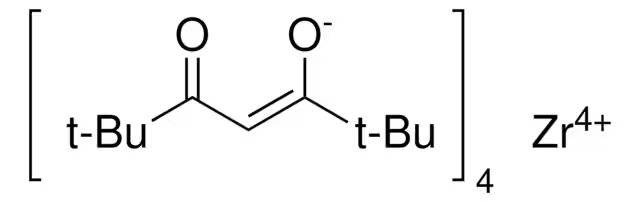
The canonical ALD process for ZrO₂ using Zr(thd)₄ (CAS 18865-74-2) was characterized by Putkonen et al. (2001, Journal of Materials Chemistry). The key parameters from this foundational work:
- ALD window: 375–400°C with ozone as the co-reactant
- Growth per cycle: 0.24 Å/cycle — low by comparison with many alternative ZrO₂ processes
- Film phase: Predominantly monoclinic ZrO₂
- Impurities: Carbon and hydrogen each reported below 0.5 at% by TOF-ERDA
- Self-limiting behavior: Confirmed within the stated temperature window
The impurity result is the headline strength. Sub-0.5% carbon and hydrogen in an oxide film deposited from an organic precursor is excellent and reflects the clean combustion of the thd ligand by ozone at elevated temperature. For applications where minimal carbon contamination is non-negotiable — high-κ dielectric stacks, optical coatings, diffusion barriers — this impurity performance is difficult to match with lower-temperature processes that may retain more ligand-derived carbon.
The Temperature Budget Tradeoff
The constraint is equally clear: 375–400°C is high. For comparison, tetrakis(dimethylamido)zirconium (TDMAZ) with ozone provides an ALD window at 200–250°C (Liu et al., 2019, Nanoscale Research Letters) with a growth per cycle of approximately 0.125 nm/cycle. The amide-based process accesses a much lower thermal budget, which matters for integration with temperature-sensitive substrates, back-end-of-line metallization, and 3D device architectures where thermal exposure must be minimized.
This tradeoff is not a deficiency of Zr(thd)₄ — it is a characteristic of the β-diketonate ligand class. The strong chelation and steric protection that give thd precursors their handleability and thermal delivery stability also raise the temperature required for complete ligand removal during the ALD surface reaction. Process teams choosing between thd and amide precursors are making a thermal-budget-versus-impurity tradeoff, and the right answer depends on the specific integration requirements of the target device stack.
Vapor Pressure and Delivery
Vendor COA data for Zr(thd)₄ reports a vapor pressure of approximately 1 Torr at 180°C — consistent with practical sublimation and transport at reduced pressure. Peer-reviewed thermodynamic studies by Fulem et al. (2004, Journal of Crystal Growth) and Morozova et al. (1996, Journal of Thermal Analysis) provide measured vapor-pressure data for zirconium β-diketonates that enable delivery system design.
The NIST Chemistry WebBook maintains a phase-change data compilation for Zr(tmhd)₄ (CAS 18865-74-2) with primary-source DOIs for sublimation enthalpy measurements. Process engineers designing bubbler or sublimer delivery systems should reference these data rather than relying on the commonly stated "sublimes at 180–220°C" — which is directionally correct but not a single intrinsic constant. Sublimation behavior depends on pressure, apparatus geometry, and carrier gas flow, and should be characterized in the specific delivery system being used.
CAS Number Warning: CAS 18865-74-2 corresponds to the tetrakis(2,2,6,6-tetramethyl-3,5-heptanedionato)zirconium complex used in ALD. CAS 17501-44-9 corresponds to a different zirconium acetylacetonate complex. Procurement teams should verify CAS numbers carefully, as these are occasionally conflated in catalog listings.
Cu(thd)₂: Metallic Copper, Oxide Phase Control, and Substrate Dependence
Metallic Copper ALD
ALD of metallic copper using Cu(thd)₂ as the metal source and H₂ as the reducing co-reactant has been demonstrated by Mane and Shivashankar (2005, Journal of Crystal Growth). The process uses Cu(thd)₂ vaporization at approximately 120–140°C with ultrahigh-purity gases (Ar carrier, H₂ reactant, N₂ purge) and yields highly textured (111)-oriented copper films.
Reported resistivity values range from approximately 4.25 µΩ·cm for 20 nm films to approximately 1.78 µΩ·cm for 120 nm films, with excellent adhesion on TiN/TaN barrier layers at 300°C (Mane and Shivashankar, 2004, Materials Science in Semiconductor Processing). These values approach bulk copper resistivity (1.68 µΩ·cm) at greater film thicknesses, confirming that Cu(thd)₂-derived films can achieve the electrical performance required for interconnect metallization.
However, Cu(thd)₂ ALD for metallic copper is frequently described as substrate- and catalyst-dependent. Seed layers (Pt, Pd, or pre-deposited Cu) are used in several reported processes to enable nucleation. This substrate dependence is a practical constraint that limits universality — teams evaluating Cu(thd)₂ for metallic copper must characterize nucleation behavior on their specific substrate stack rather than assuming it will replicate published results on different underlayers.
Copper Oxide Phase Control
For Cu₂O and CuO films, Cu(thd)₂ MOCVD demonstrates that deposition temperature strongly affects oxidation state. Pellegrino et al. (2022, Materials) showed Cu₂O stabilization at lower temperatures (e.g., 250°C) and CuO at higher temperatures (e.g., 400°C), with Cu₂O exhibiting p-type resistivity in the 31–83 Ω·cm range and optical bandgap values of approximately 1.99–2.41 eV — properties relevant to hole-transporting layers in perovskite solar cells.
The oxidation-state selectivity — controlled by temperature, oxygen partial pressure, and reductant availability — is a feature, not a limitation. It enables a single precursor to access multiple copper-containing phases depending on process conditions, which simplifies precursor inventory management for facilities running multiple copper-based processes.
The Halide-Free Advantage
Compared with fluorinated β-diketonates (e.g., Cu(hfac)₂), Cu(thd)₂ eliminates fluorine-containing ligands entirely. This avoids the HF-related substrate etching, fluorine incorporation, and corrosion concerns that are repeatedly flagged in the copper deposition literature (Gordon et al., 2015, ECS Journal of Solid State Science and Technology). For applications where fluorine contamination is a reliability risk — particularly in advanced interconnect metallization — the non-fluorinated thd ligand provides a meaningful materials compatibility advantage.
The tradeoff is that newer copper precursor classes — amidinates, guanidinates, and NHC-stabilized Cu(I) compounds — have been developed specifically to provide more robust low-temperature ALD behavior without substrate dependence constraints. Cu(thd)₂ remains relevant for specific integration schemes but is not universally preferred for all copper ALD applications.
Gd(thd)₃: Rare-Earth Oxide ALD With Known Constraints
The Niinistö Process
Niinistö et al. (2005, Journal of Crystal Growth) reported the foundational Gd₂O₃ ALD process using Gd(thd)₃ with ozone at 300°C:
- Growth per cycle: Approximately 0.3 Å/cycle
- Film quality: Uniform, smooth, polycrystalline, oxygen-rich
- Impurities: Approximately 2.3 at% carbon, approximately 1.7 at% hydrogen
These impurity levels — substantially higher than the sub-0.5% achieved with Zr(thd)₄/O₃ — reflect the difficulty of achieving complete thd ligand removal at 300°C with ozone. For gate dielectric or capacitor applications where carbon and hydrogen must be minimized, this impurity load may require post-deposition annealing or co-optimization with oxidant dose and pulse sequence.
Alternative Routes and Surface Chemistry Challenges
Alternative Gd₂O₃ processes seek either higher growth rate or lower thermal budget. Vitale et al. (2012, Journal of Vacuum Science & Technology A) reported plasma-assisted ALD using Gd(iPrCp)₃ with O₂ plasma, achieving approximately 1.4 Å/cycle at 250°C — nearly 5× the growth rate of the thd/O₃ process. However, plasma processes introduce different surface chemistry, potential substrate damage, and conformality limitations in high-aspect-ratio structures.
Han et al. (2015, Chemical Vapor Deposition) examined the surface chemistry of ozone-based ALD using Gd(iPrCp)₃/O₃ and found that oxidant generation conditions (e.g., O₂/N₂ ratio feeding the ozone generator) influence surface hydroxylation and can cause parasitic CVD. This sensitivity is attributed partly to the hygroscopic nature of Gd₂O₃ — a characteristic that makes rare-earth oxide ALD unusually sensitive to reactor water background and process chamber conditioning.
Electrical Properties Context
For context, Kukli et al. (2007, Chemical Vapor Deposition) reported ALD Gd₂O₃ films (using a non-thd precursor) with permittivity of approximately 15.6 and breakdown fields up to approximately 8 MV/cm in MOS capacitor structures. These values represent target property ranges for gate-quality Gd₂O₃, though actual electrical performance depends strongly on oxygen deficiency, crystallographic phase, and interfacial layer quality — all of which are process-dependent rather than precursor-determined.
Process-Window Thinking: A Practical Evaluation Model
Why Single-Number Comparisons Fail
The temptation to compare precursors by single parameters — vapor pressure at one temperature, GPC under one condition set, purity specification — consistently misleads selection decisions. Precursor performance is a system property, not an intrinsic material property. The same Zr(thd)₄ lot that produces excellent ZrO₂ in one reactor configuration may underperform in another due to differences in carrier gas flow, ozone concentration, substrate temperature uniformity, or purge efficiency.
Staged Qualification Protocol
Effective programs evaluate precursors through a staged sequence rather than a single pass/fail gate:
Stage 1 — Transport and delivery: Verify vapor pressure behavior across the practical source temperature range. Confirm delivery stability (no premature decomposition, no condensation in transfer lines) under realistic operating conditions. Characterize residual particle behavior if the precursor is delivered as a sublimed solid.
Stage 2 — Surface reaction consistency: Confirm self-limiting growth behavior across the claimed ALD window. Measure GPC reproducibility over multi-hundred-cycle runs. Characterize the impurity profile (C, H, N, halides as applicable) by XPS, SIMS, or ERDA under steady-state conditions.
Stage 3 — Film properties under throughput constraints: Evaluate electrical, optical, and compositional properties at cycle times compatible with manufacturing throughput. The critical test is whether acceptable film quality can be maintained when pulse and purge times are shortened toward production-relevant values — many ALD processes that work beautifully at research-scale cycle times degrade when pushed toward manufacturing economics.
This sequence surfaces real bottlenecks early and prevents the common failure mode of discovering, during tool qualification or pilot production, that a precursor which performed well in development cannot deliver acceptable throughput in the production environment.
Market Context
The global metal-organic precursors market is estimated at approximately $1.7–1.9 billion as of 2024, with a projected CAGR of approximately 10.4% through 2029 (TECHCET estimates). Growth is driven by advanced node semiconductor manufacturing (gate-all-around transistor architectures beyond 5 nm require new materials and thinner, more precisely controlled films), MEMS and sensor applications, and emerging energy technology applications (perovskite solar cells, solid-state battery interfaces).
The CHIPS Act and associated domestic semiconductor investment programs (e.g., the Hemlock Semiconductor award in January 2025) are accelerating demand for US-based precursor manufacturing capacity — a structural advantage for domestic suppliers who can provide the combination of material quality, supply security, and regulatory compliance documentation that advanced fabs require.
Evidence Limits
- Physical constants (vapor pressure, sublimation temperature) are condition-dependent. Published values from one measurement apparatus may not precisely predict behavior in a different delivery system. Treat literature values as directional and validate in your own equipment.
- ALD process parameters from published literature are highly tool-specific. Reactor geometry, pumping capacity, oxidant delivery method, and substrate loading all affect process behavior. Literature transfer should be treated as hypothesis-generating, not recipe-confirming.
- Film property data for Gd₂O₃ electrical performance cited here uses a non-thd precursor. These values represent target ranges, not guaranteed outcomes for Gd(thd)₃-derived films.
- Market size estimates are third-party projections with inherent uncertainty in forecast methodology and scope definition.
Where thd Chemistry Fits
TMHD/thd precursors are not legacy technology being overtaken by newer chemistry classes. They occupy a specific and defensible position: halide-free metal delivery with manageable handling requirements, well-characterized thermodynamics, and established supply chains. For metals where amide or cyclopentadienyl alternatives exist, thd precursors compete on impurity profile at high temperature and handling convenience. For metals where thd remains among the best available options — certain rare earths, alkaline earths, and early transition metals — they are not merely competitive but essential.
The teams that extract the most value from thd precursors are those that approach them with process-window engineering discipline: staged qualification, system-specific characterization, and realistic assessment of the thermal-budget-versus-purity tradeoff rather than optimism built from isolated datasheet metrics.