DMTMM in 2026: Where Water-Compatible Amide Coupling Stands Today
A practical technical perspective on DMTMM selection: robust use-cases, common misconceptions, and where alternative coupling strategies still outperform.
The Selection Problem That Keeps Recurring
Process chemists and bioconjugation scientists choose coupling reagents dozens of times per year, and most of those decisions are made by habit rather than by analysis. The dominant incumbents — HATU for difficult couplings, HBTU and PyBOP for routine SPPS, EDC/NHS for aqueous bioconjugation — are chosen because they were chosen last time. They work well enough. They are understood well enough. And their limitations are absorbed as operational constants rather than questioned as design constraints.
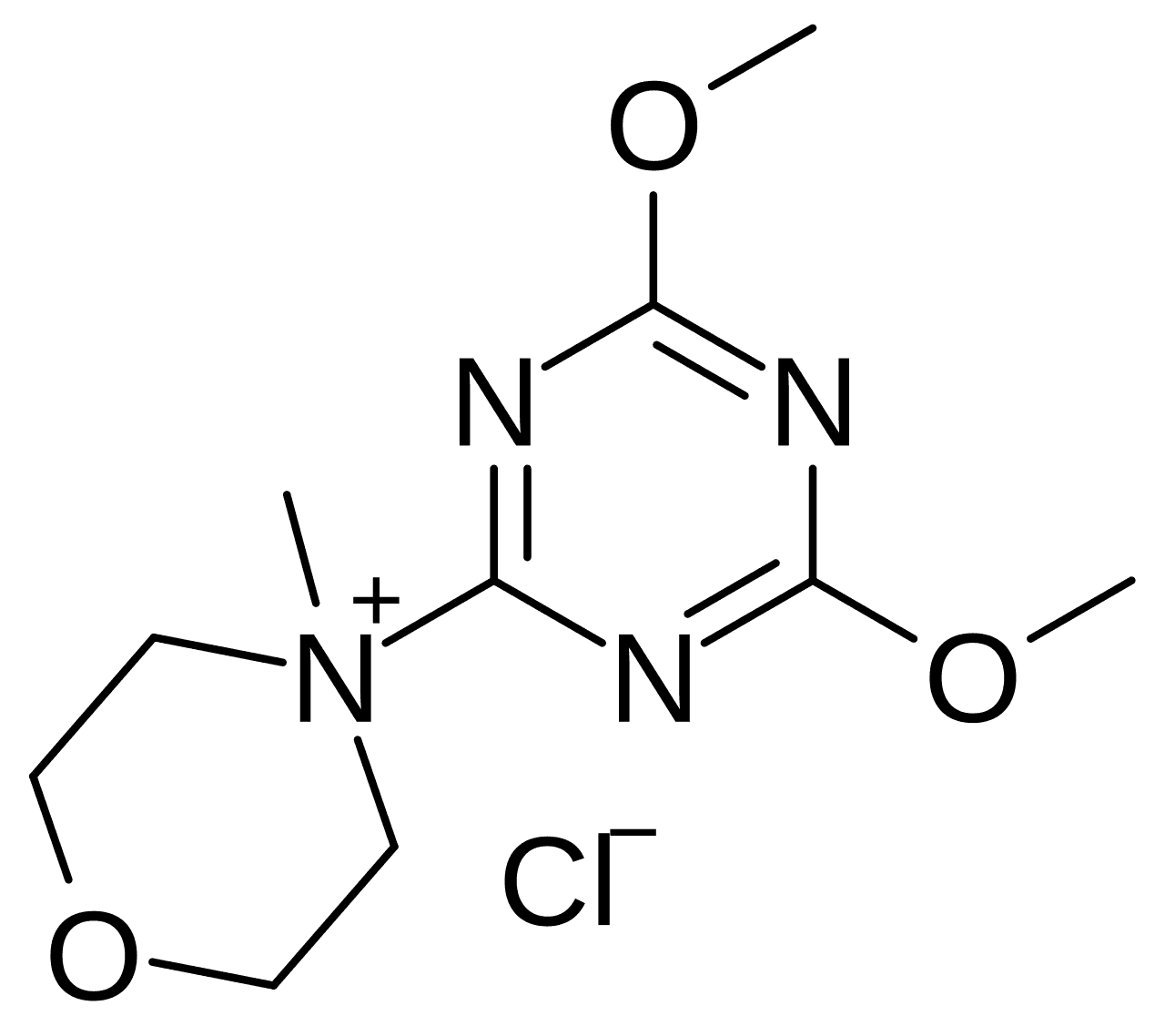
DMTMM (4-(4,6-dimethoxy-1,3,5-triazin-2-yl)-4-methylmorpholinium salts) enters this landscape not as a universal replacement but as a conditional optimizer. In specific application windows — aqueous and mixed-solvent amidation, on-DNA chemistry, biomaterial conjugation — DMTMM offers genuine advantages that the incumbent reagent families cannot match. In other contexts, it does not. The fastest way to waste development cycles is to adopt DMTMM as a trend default rather than deploying it where its chemistry genuinely solves a problem.
This article maps the specific windows where DMTMM excels, the known limitations that constrain its use, and the decision framework that helps process teams choose correctly.
Where DMTMM Outperforms: Three High-Confidence Applications
Aqueous Biopolymer Conjugation
The strongest published evidence for DMTMM's competitive advantage comes from systematic comparisons in aqueous biopolymer systems. D'Este and colleagues at the AO Foundation published a detailed analysis of hyaluronan functionalization comparing DMTMM directly with EDC/NHS. At matched feed ratios, DMTMM produced superior yields while remaining effective without the tight pH control that EDC/NHS requires for consistent performance.
This advantage is operationally significant because pH management is one of the most common failure modes in EDC/NHS conjugation workflows. EDC activation is pH-sensitive — the reactive O-acylisourea intermediate is formed optimally near pH 4.5–6.0 but undergoes competitive hydrolysis at rates that vary with buffer composition, temperature, and protein concentration. NHS or sulfo-NHS coupling shifts the optimal pH upward but introduces a two-step activation-conjugation sequence with timing constraints. DMTMM simplifies this by producing a stable activated ester (dimethoxytriazinyl ester) in water that is less susceptible to hydrolysis, enabling single-step conjugation with broader pH tolerance.
For biomaterial and polymer conjugation teams — particularly those working with hyaluronic acid, alginate, chitosan, or other polysaccharide-based systems — this represents a genuine workflow improvement, not merely an incremental yield bump.
On-DNA Amidation for DEL Chemistry
DNA-encoded library (DEL) synthesis operates under constraints that most coupling chemistry was not designed for. The reaction environment is aqueous by necessity (DNA is the substrate), concentrations are typically low, steric demands are high (building blocks must couple to DNA-tethered amines through hindered positions), and the analytical standard for success is stringent (incomplete coupling reduces library quality and screening hit rates).
A 2024 report demonstrated that DMTMM hexafluorophosphate (PF₆) improves on-DNA amidation conversion rates compared with both HATU and DMTMM chloride, particularly for sterically hindered coupling partners. This enables expanded building-block scope and higher-purity DEL libraries — directly relevant to the pharmacological diversity that justifies the DEL approach.
The PF₆ counter-ion matters here. F. Hoffmann-La Roche holds a patent describing post-synthetic nucleic-acid modification using a DMTMM-type cation with weakly coordinating counter-anions (BF₄⁻ and PF₆⁻ are specifically cited), reinforcing that salt form selection for DMTMM is not academic — it is application-driven. For DEL applications, PF₆ is not "another salt." It is a performance-differentiated reagent.
Structural Proteomics Cross-Linking
Leitner and colleagues at ETH Zurich developed carboxyl-group cross-linking workflows using DMTMM at neutral pH for structural proteomics. The application relies on DMTMM's ability to activate carboxylate side chains (Asp, Glu) in proteins under physiological-like conditions, forming zero-length cross-links with nearby lysine residues. Follow-on optimization work demonstrated tunable product balance and broader cross-link coverage.
Mohammadi at the Université Libre de Bruxelles has published DMTMM-based structural proteomics workflows independently, confirming the reagent's utility in this application space. The neutral-pH compatibility is the critical enabler — most alternative cross-linking approaches either require non-physiological conditions or produce non-zero-length spacers that complicate structural interpretation.
Where DMTMM Is Competitive but Not Clearly Superior
Solid-Phase Peptide Synthesis
In SPPS, DMTMM has been evaluated as an alternative to PyBOP and other phosphonium reagents. A comparative study published in Synlett reported that DMTMM produces comparable yields under the evaluated conditions and positions it as an economical alternative. The pricing data supports this framing: DMTMM chloride at 25 g is available at approximately $11.20/g from major catalog suppliers, compared with HATU at approximately $20.56/g (25 g) and HBTU at approximately $14.40/g (25 g). DMTMM·BF₄ at 1 g lists at approximately $105/g — reflecting the premium for lower-volume specialty salts.
However, "economical alternative with comparable yields" is a weaker value proposition than "clearly better performance." In SPPS applications where the incumbent reagent is already working well, switching costs (revalidation, regulatory documentation updates for GMP workflows, impurity profile changes) may not be justified by marginal cost savings alone. DMTMM is best positioned in SPPS for new method development, cost-optimization programs, or situations where the incumbent reagent has known failure modes on specific sequences.
Known Limitations That Should Be Addressed Proactively
Fluorophore Quenching
One published study documents xanthene dye quenching and formation of adducts with the dimethoxytriazine moiety when DMTMM is used at high concentrations with fluorescently labeled targets. The recommendation is to avoid high DMTMM concentrations when targets carry xanthene-family fluorophores (fluorescein, rhodamine).
This is a narrow but important constraint. Teams performing labeled bioconjugation should verify fluorophore compatibility before committing to DMTMM. The limitation does not apply to unlabeled conjugation workflows or to non-xanthene fluorophore systems, but it should appear in application guidance rather than being discovered during troubleshooting.
Triazine Side Products
In polymer and peptide systems, formation of triazine-derived side products has been observed. Biomaterials studies report formation of triazine residues and hypothesized tyrosine-associated adducts in certain systems. These side products are generally manageable through optimization of DMTMM stoichiometry, reaction time, and temperature — but they mean that DMTMM workflows require analytical validation of the specific side-product profile in each new system.
Process teams should not assume that conditions optimized in one substrate class will transfer directly to another. DMTMM side-product formation is condition-dependent, and each new application requires its own impurity-profile characterization.
The "Universal Superiority" Misconception
The most common overstatement about DMTMM is that it outperforms legacy coupling systems across all applications. This is not supported by the literature. HATU remains the reagent of choice for sterically demanding peptide couplings in organic solvents. Carbodiimides (DIC/DCC) remain standard for simple amidations where cost and availability dominate. EDC/NHS workflows are well-validated for protein bioconjugation and may be preferred in regulatory contexts where established precedent reduces documentation burden.
DMTMM wins when the application involves water-tolerant activation, when pH control is operationally difficult, when the PF₆ salt provides performance differentiation (DEL), or when substrate constraints favor the dimethoxytriazinyl activation pathway over alternatives. Outside those windows, forcing DMTMM into a workflow it was not designed for creates avoidable complexity.
The Market Context: Why Reagent Selection Pressure Is Increasing
The backdrop for coupling reagent decisions in 2026 is a global market undergoing structural expansion. The peptide synthesis reagents market was estimated at approximately $729.9 million in 2024, with projections reaching approximately $1.5 billion by 2034. The peptide CDMO market grew from approximately $2.03 billion in 2021 to an estimated $4.32 billion by 2030 — every CDMO expansion represents a new qualification opportunity for reagent suppliers. The antibody-drug conjugate market, estimated at approximately $12.26 billion in 2024 with projections to $32.11 billion by 2033, is driving parallel growth in conjugation chemistry capacity where DMTMM's aqueous compatibility is most directly relevant.
The oligonucleotide synthesis market — estimated around $3.64 billion in 2025 growing to $10.86 billion by 2033 — is relevant because nucleic-acid labeling and DNA-compatible chemistry frequently relies on amide formation steps under water-tolerant conditions. This is exactly the application space where DMTMM PF₆ has demonstrated clear performance advantages over incumbent reagents.
These numbers do not prove DMTMM superiority — they indicate category opportunity. The organizations that will capture disproportionate value are those that match reagent selection to specific application constraints rather than defaulting to whatever the last project used.
Named Researchers and Groups Driving DMTMM Adoption
Several research groups have been instrumental in establishing DMTMM's evidence base and expanding its application envelope:
Matteo D'Este (AO Foundation, Switzerland) published the systematic DMTMM versus EDC/NHS comparison on hyaluronan that provides the strongest head-to-head performance data in aqueous biopolymer systems. This work is frequently cited by biomaterial formulation groups evaluating water-tolerant conjugation options.
Alexander Leitner (ETH Zurich) developed the carboxyl-group cross-linking protocol using DMTMM at neutral pH for structural proteomics, with follow-on work demonstrating tunable cross-link coverage. This methodology has influenced how structural biology groups approach distance-constraint generation.
Azadeh Mohammadi (Université Libre de Bruxelles) has published independent DMTMM-based structural proteomics workflows, confirming the method's reproducibility and utility across research groups.
Takumi Hosozawa (Nissan Chemical, Japan) and related industrial research teams have contributed to understanding DMTMM behavior in materials science contexts, including polymer functionalization workflows relevant to industrial coating and device applications.
The existence of an independent, multi-group publication record matters for commercial adoption. Process teams in regulated environments — particularly CDMOs operating under ICH Q7 — are more willing to qualify a reagent that has been validated across multiple independent laboratories than one supported only by supplier-generated data.
A Decision Framework for Process Teams
Rather than asking "DMTMM or not?", the productive question is a four-part assessment:
1. Solvent envelope. Is the reaction best run in aqueous, mixed-aqueous, or purely organic media? If aqueous compatibility is a genuine constraint (not just a preference), DMTMM moves to the top of the evaluation list. If the reaction runs cleanly in DMF or DMSO with no water, the incumbent may be perfectly adequate.
2. Impurity criticality. Which impurity classes are hardest to clear downstream? If urea-type byproducts from carbodiimides or guanidinylation products from uronium reagents are creating purification burdens, DMTMM's different side-product profile may offer a net advantage even if raw conversion rates are similar.
3. Throughput bottleneck. Is throughput limited by the coupling chemistry, the workup/purification, or the analytical characterization? DMTMM's stable activated ester can simplify workup in some systems, but if the bottleneck is elsewhere, switching coupling reagents will not solve it.
4. Salt form selection. Chloride for general-purpose aqueous coupling. BF₄ for stability-sensitive applications or peptide synthesis. PF₆ for DEL and on-DNA chemistry where conversion rate improvements have been directly demonstrated. The salt is not interchangeable — it is application-matched.
Evidence Limits
- Performance claims for DMTMM are application-specific and should not be generalized across substrate classes without direct testing.
- Published comparisons (DMTMM vs EDC/NHS, DMTMM vs HATU) are typically conducted in specific model systems. Transferability to your substrate requires validation.
- Market demand narratives (peptide synthesis reagent market growth, GLP-1 demand) are not evidence of DMTMM-specific superiority. They indicate category opportunity, not reagent-level performance.
- Pricing data from catalog sources varies significantly by region, pack size, and contract structure. Use catalog prices for directional guidance, not procurement planning.
Practical Conclusion
DMTMM earns its place in process chemistry when teams treat it as a precision tool matched to specific application constraints rather than a universal upgrade. The strongest use cases — aqueous biopolymer conjugation, DEL amidation with PF₆, structural proteomics cross-linking — are backed by published head-to-head comparisons with concrete performance data. The competitive but not clearly superior applications — routine SPPS, standard organic-solvent amidation — require case-by-case evaluation against established workflows.
The broader coupling reagent market — estimated at approximately $729.9 million for peptide synthesis reagents alone in 2024 — is growing because the demand for amide bond formation is increasing across peptides, ADCs, oligonucleotide labeling, and biomaterial functionalization. DMTMM's opportunity within that market is real, but it is application-specific rather than universal. The salt set (chloride for general aqueous work, BF₄ for stability-sensitive SPPS, PF₆ for DEL and on-DNA performance) is the right way to think about DMTMM — not as one reagent but as a platform matched to different constraints.
In 2026, the winning strategy for coupling reagent selection remains unchanged: narrow claims, broad comparative testing, and route decisions made on data in your own system, not on reputation or trend momentum.